The United Nations Has Raised Human Rights Concerns About UK Family Courts
Mar 30, 2026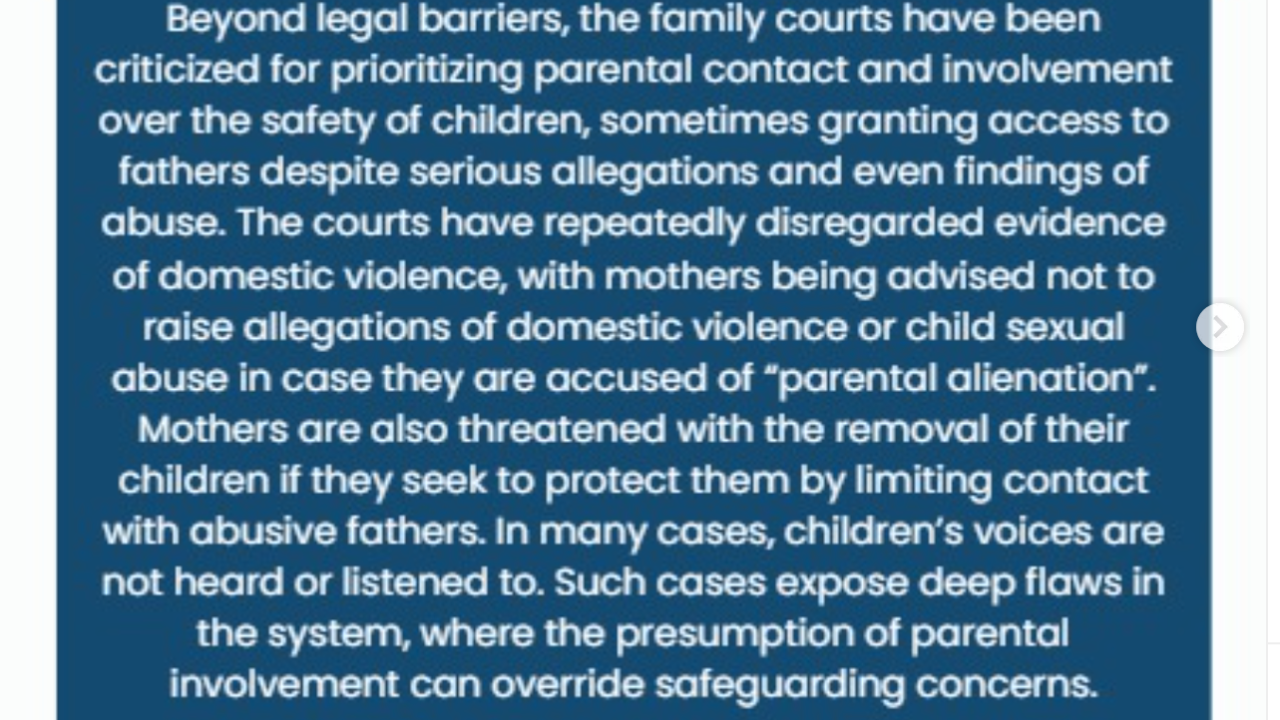
The United Nations has visited the United Kingdom and reported back.
In February 2024, the UN Special Rapporteur on violence against women and girls, Reem Alsalem, conducted an official country visit to the United Kingdom at the invitation of the Government. She visited London, Birmingham, Manchester, Glasgow, Edinburgh, Belfast and Cardiff. She met with ministers, parliamentarians, national human rights institutions, civil society organisations, academics and survivors. Her comprehensive report — A/HRC/59/47/Add.1 — was published in June 2025 and presented to the UN Human Rights Council at its 59th session.
This is not a thematic survey of patterns across multiple jurisdictions. This is a report about the United Kingdom, based on a physical visit, conducted at the Government's own invitation.
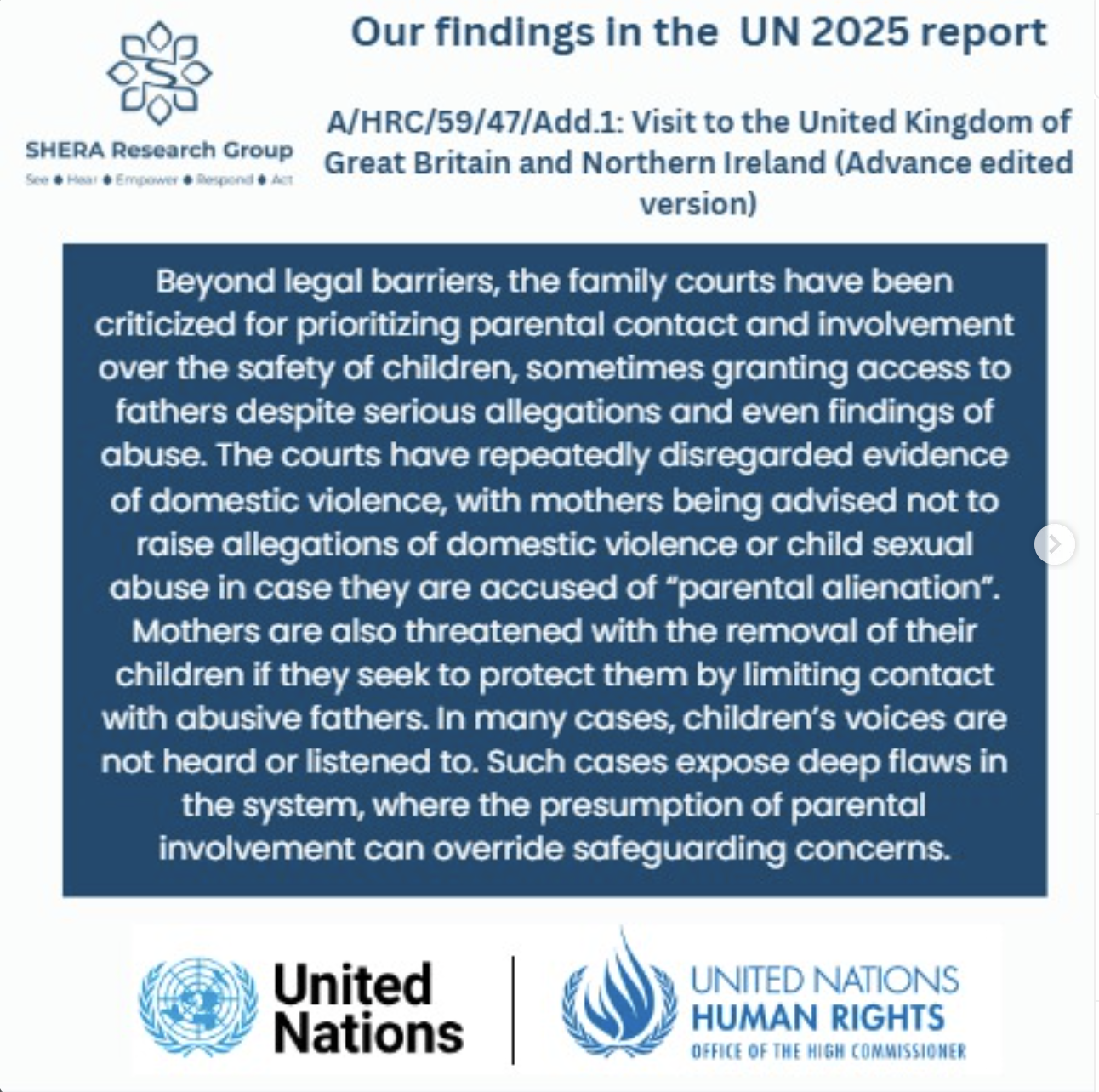
The findings on the family courts are set out in paragraph 82 of the report. They are the Special Rapporteur's own findings — not submissions from third parties. This is what she concluded:
The family courts have been criticised for prioritising parental contact and involvement over the safety of children, sometimes granting access to fathers despite serious allegations and even findings of abuse. The courts have repeatedly disregarded evidence of domestic violence, with mothers being advised not to raise allegations of domestic violence or child sexual abuse in case they are accused of parental alienation. Mothers are also threatened with the removal of their children if they seek to protect them by limiting contact with abusive fathers. In many cases, children's voices are not heard or listened to. Such cases expose deep flaws in the system, where the presumption of parental involvement can override safeguarding concerns.
That is paragraph 82 of a UN report published in 2025, following a physical visit to this country.
This was not the first time the UN documented this pattern
In 2023, the same Special Rapporteur submitted Report A/HRC/53/36 to the Human Rights Council. That thematic report examined custody proceedings and violence against women and children across multiple jurisdictions. Submissions received from the United Kingdom documented that mothers raising safeguarding concerns were experiencing considerable pressure from courts and their lawyers to agree to contact arrangements, sometimes without any assessment of child welfare concerns or the views of the children. Women reported being advised by their legal representatives not to raise allegations of domestic violence as it would work against them.
The 2023 report's central finding: the discredited and unscientific pseudo-concept of parental alienation is used in family law proceedings by abusers as a tool to continue their abuse and coercion, to undermine and discredit allegations of domestic violence made by mothers who are trying to keep their children safe.
Two years later, the Special Rapporteur came to the United Kingdom in person. Her paragraph 82 finding is consistent with what the UK submissions told her in 2023. Coming to this country and seeing it for herself did not change the picture.
What the Special Rapporteur recommended
Having visited the United Kingdom and documented these findings, the Special Rapporteur made a formal recommendation to the Government in paragraph 88(g) of the 2025 report. She recommended that the UK Government urgently and swiftly prohibit the use of parental alienation and related pseudo-science concepts, and appoint only experts who are fully qualified psychologists or psychiatrists regulated by the Health and Care Professions Council, with regular accredited domestic abuse training.
That is a recommendation made directly to the UK Government, following a country visit, published on the international human rights record in 2025.
The three-document chain
The Ministry of Justice's own Harm Report in 2020 documented that domestic abuse victims were being systematically mislabelled as perpetrators of parental alienation in the UK's family courts. The state named the problem in its own words.
In 2023, the UN Special Rapporteur documented the same pattern internationally, with specific UK submissions included. She recommended that states legislate to prohibit the use of parental alienation in family law cases.
In 2025, she came to the United Kingdom, visited seven cities, met the Government, and published a country-specific report finding that the problem persists — in paragraph 82, in her own words, as her own conclusion.
Three independent documents. The same finding. Each one strengthens the chain.
What this means
This is not a domestic criticism from a campaign group. It is not an opinion from a commentator. It is the conclusion of the United Nations Special Rapporteur on violence against women and girls, published in a formal report to the Human Rights Council, following a physical visit to this country conducted at the Government's invitation.
When the United Nations comes to the United Kingdom, meets with ministers, gathers evidence on the ground, and reports that the family courts are prioritising parental contact over the safety of children, that children's voices are not being heard, and that mothers are being advised not to raise abuse allegations for fear of being accused of parental alienation — that is a finding. It is on the international human rights record. It deserves to be treated as one.
Sources
- UN Human Rights Council (2023). Custody, violence against women and violence against children. Report of the Special Rapporteur on violence against women and girls, Reem Alsalem (A/HRC/53/36). https://www.ohchr.org/en/documents/thematic-reports/ahrc5336-custody-violence-against-women-and-violence-against-children
-
UN Human Rights Council (2025). Visit to the United Kingdom of Great Britain and Northern Ireland (A/HRC/59/47/Add.1:) https://www.ohchr.org/en/documents/country-reports/ahrc5947add1-visit-united-kingdom-great-britain-and-northern-ireland
- Ministry of Justice (2020). Assessing risk of harm to children and parents in private law children cases.
- Domestic Abuse Commissioner (2023). The Family Court and Domestic Abuse: Achieving Cultural Change.