#1 Amazon International Bestseller (US)

Get In Touch

The Money Blog

Lorem ipsum dolor sit amet, metus at rhoncus dapibus, habitasse vitae cubilia odio sed. Mauris pellentesque eget lorem malesuada wisi nec, nullam mus. Mauris vel mauris. Orci fusce ipsum faucibus scelerisque.

How StoryQuest Caught Canadian Educators Attention

cultural bridge education & storytelling storyquest™ spotlight Sep 19, 2025
 

When TEACH Magazine, one of Canada's leading education publications, featured StoryQuest™, I knew something significant was happening.

A methodology born from constraint over FaceTime, refined in Bradford classrooms, was now catching the attention of educators thousands of miles away. 

Canadian educators saw what UK teachers were achieving and wanted to understand how.

This is what happens when methodology works: it travels. Across cities. Across countries. Across any barrier that stands between children and their voices.

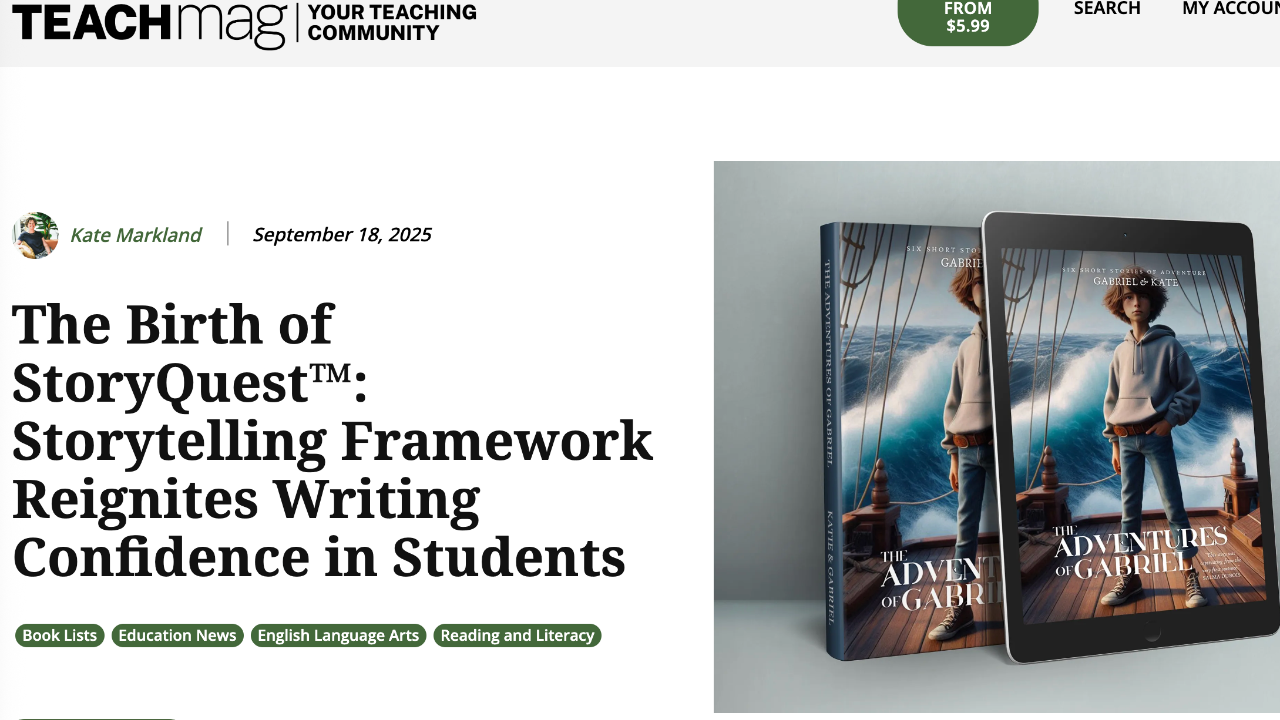
Today, TEACH Magazine published "The Birth of StoryQuest™: Storytelling Framework Reignites Writing Confidence in Students", introducing Canadian educators to an approach that's transforming how children experience literacy.

Here's why this matters, and what Canadian educators are noticing about work that started with one hour weekly on FaceTime.

The Story That Caught Canadian Attention

The article opens with the truth we've never hidden:

"In the winter of 2023, I faced an unimaginable challenge: separation from my 10-year-old son, Gabriel, due to a welfare case shaped by policies that, in our case, clashed with the needs of children and families. For 18 months, our connection was reduced to one precious hour a week on FaceTime."

Canadian educators didn't shy away from this origin story. They leaned into it.

Because they recognised something their UK counterparts already knew: the most powerful innovations often emerge from the most difficult constraints.

When Gabriel and I had one hour weekly, we couldn't waste time on compliance or perfectionism. We needed connection. We needed creativity. We needed his voice to matter.

So I asked him one question: "Would you like to be the hero of your own story?"

His answer was immediate: "Yes!"

By our next video call, Gabriel was already spinning tales of defeating sea monsters, rescuing phoenixes, and adventuring with Platy the platypus. I became his scribe. He became the author.

What began as survival became methodology.

What Canadian Educators Are Seeing

TEACH Magazine didn't just feature our story. They featured what three UK teachers said about implementing StoryQuest™ in their classrooms.

Claire Light, Quality of Education Leader:

"From the very start of the session, every pupil was engaged and couldn't wait to get started. Taking away boundaries of grammatical perfection freed up creativity, and pupils really worked well with their scribe partners, allowing a first draft of their story to be spoken, not written.

I could see their confidence growing throughout the day, particularly for previously reluctant writers. Pupils cannot wait to see their published stories and share them across our school community and beyond."

Tom Hirst, Head of English (also featured in BBC News):

"We sometimes forget about writing for pleasure and what that can do for our kids. A lot of boys and girls have a fear of the blank page, you can do all the teaching, but they sort of shut down when asked to write a story. So it was such a great experience to see them really joyful, talking about their stories. They loved it."

Thieb Khan, Year 5/6 Teacher:

"This program has had a genuinely transformative effect on our pupils' engagement with reading and writing. By placing creativity and storytelling at the heart of the process, it has reignited a sense of excitement and ownership in literacy that we don't always see through more traditional approaches.

Perhaps most powerful of all are the reflections from children themselves."

Three schools. Three perspectives. One consistent message: This works.

What Children Told Canadian Readers

TEACH Magazine gave significant space to children's voices. Not summarized. Not paraphrased. In their exact words:

From Claire Light's students:

  • "I loved being an author today. I got to choose my own ideas and unleash my imagination."
  • "It was fun because I got to write what I wanted. I'm hoping I'll make someone happy if they read my book."

From Tom Hirst's students:

  • "I believed in myself so I could create things I didn't even know I could do."
  • "It felt amazing to be an author because I like writing stories and sharing my ideas with others."

From Thieb Khan's students:

  • "I like writing my own story with no rules... I'm looking forward to finishing my story and to make more with only my rules! Not anybody else's."
  • "It made me feel proud and responsible to be able to make my own story without support or a plan."
  • "I really enjoyed it because we got to imagine our own story and write it down."

Canadian educators reading this recognised what UK teachers already know: children discover not just a love of storytelling, but a belief in their ability to tell stories that matter.

The Methodology That Travels

What makes StoryQuest™ work in Bradford works in Gloucestershire. And what works in UK classrooms translates to Canadian contexts because the principles are universal:

Children collaborate in pairs, one as storyteller, one as scribe.

No blank page paralysis. No handwriting overwhelm. No spelling anxiety during creation.

Just pure imagination flowing freely, captured exactly as spoken.

Grammar and editing come later. Imagination comes first.

In classrooms where children once froze before blank pages, teachers now hear eager voices, laughter, and unbridled joy.

The process mirrors what Gabriel and I created:

He narrated. I scribed. He edited. We celebrated.

That simple framework, transferred to classroom pairs, achieves what traditional approaches struggle to reach: 100% engagement across all learners.

As TEACH Magazine noted:

"When children are trusted to tell their own tales, magic unfolds, uniting their voices and written words in shared joy."

Why Bradford Became the Testing Ground

TEACH Magazine gave space to explain why Bradford specifically:

Bradford is Gabriel's grandmother's childhood home. A place I visited often as a young girl, wide-eyed as my grandfather spun vivid tales I still carry.

Oral storytelling wasn't novelty in our family. It was legacy. A gift passed across generations.

When a family friend, a retired educationist in Bradford, saw what Gabriel and I had created, she opened doors to Bradford's classrooms.

From there, StoryQuest™ took root.

The Canadian article positions this not as random choice but as cultural continuity: storytelling traditions passed through generations, now formalized into methodology that serves all children.

What Makes This International

The TEACH Magazine feature matters because it demonstrates something crucial: StoryQuest™ isn't bound by geography, culture, or educational system.

The principles travel because they're rooted in universal truths:

  1. Children have stories worth telling (true in UK, Canada, everywhere)
  2. Blank pages create anxiety (universal challenge)
  3. Oral expression precedes written fluency (developmental reality)
  4. Partnership reduces isolation (human need for connection)
  5. Creative autonomy generates engagement (intrinsic motivation principle)

Canadian educators facing the same challenges UK teachers face—reluctant writers, blank page fear, boys disengaging from literacy, recognise these truths immediately.

The methodology works because it honours how children naturally learn when they feel heard.

The Broader Context

TEACH Magazine positioned StoryQuest™ within trauma-informed practice:

"As a former physiotherapist and educator, I understood the devastating realities of Adverse Childhood Experiences (ACEs). Self-expression, identity-building, and emotional literacy aren't luxuries—they're lifelines."

This framing matters. Canadian educators, like UK educators, are grappling with children's mental health crisis, trauma-informed practice implementation, and the intersection of wellbeing and literacy.

StoryQuest™ addresses all three simultaneously.

When children create heroes who face fears, characters who learn to ask for help, worlds where they control outcomes—they're not just writing stories. They're processing emotions through safe metaphor.

The article quotes a Bradford student:

"In a Bradford classroom, one boy keeps Gabriel's book in his tray, saying, 'Gabriel's imagination feels like mine.'"

That connection, a child in Bradford seeing himself in Gabriel's story—is what Canadian educators recognize as powerful. Identity, representation, voice.

The Power of Third-Party Validation

Here's what matters about TEACH Magazine coverage:

It's not Kate saying StoryQuest™ works. It's Canadian educators reading what UK teachers report and recognising: "This addresses problems we're facing too."

It's not promotional content. It's editorial feature in respected education publication.

It's not UK-only story. It's international methodology with universal principles.

When third-party validation comes from international sources, credibility multiplies.

BBC News featured us in UK. TEACH Magazine featured us in Canada. 

This isn't local innovation anymore. This is global methodology.

What Educators Can Learn From This

The TEACH Magazine article offers lessons for any educator considering StoryQuest™:

1. Constraint can drive innovation

The most powerful methodology emerged from the most limited circumstances. When you have constraints, you focus on what's essential.

2. Oral storytelling removes barriers

Children who freeze facing blank pages come alive when allowed to speak their stories first.

3. Partnership transforms isolation

Working in pairs—storyteller and scribe—makes creation collaborative rather than competitive.

4. Imagination precedes mechanics

Grammar and spelling matter. But not during initial creation. Protect the creative flow first.

5. Children's voices reveal transformation

The best evidence isn't teacher assessment. It's children saying "I believed in myself so I could create things I didn't even know I could do."

The Bradford to Canada Journey

From one hour weekly on FaceTime between mother and son, to Bradford classrooms transforming reluctant writers into enthusiastic authors, to Canadian education magazine recognizing the methodology's potential, this journey demonstrates something fundamental:

Good ideas travel when they're built on universal truths.

The specifics of our story are unique, Gabriel and I, the separation, the constraint, the FaceTime calls.

But the principles underlying StoryQuest™ are universal:

  • Every child has stories worth telling
  • Voice matters more than perfection
  • Partnership makes creation safer
  • Imagination needs protection during birth

Canadian educators don't need to understand our specific circumstances to recognize these truths.

They see them in their own classrooms every day.

What's Next

The Canadian feature in TEACH Magazine represents momentum building:

Media trajectory:

  • BBC News (UK national broadcaster)
  • PhysioTimes (India healthcare publication)
  • TEACH Magazine (Canada education publication)
  • Yorkshire Post, Times Radio, MSN (UK regional/national)

Academic:

  • British Psychological Society presentation
  • Journal of Novel Physiotherapy and Rehabilitation publication
  • European Conference on Education (2025)
  • Barcelona Conference on Education (2025)

School implementation:

  • 9 UK schools (Bradford, Gloucestershire)
  • 465 children documented
  • 100% engagement maintained
  • Zero behavioural incidents
  • Tom Hirst built it permanently into curriculum

From one hour weekly to international recognition. From constraint to methodology. From survival to transformation.

The Invitation to Canadian Educators

If you're a Canadian educator reading this—or any educator anywhere facing similar challenges, the TEACH Magazine article demonstrates something important:

StoryQuest™ works because it honors universal principles about how children learn when they feel heard.

You don't need our specific circumstances. You need the methodology.

You don't need Gabriel's story. You need your students' stories.

You don't need Bradford classrooms. You need the framework that makes any classroom a place where all voices matter.

The methodology travels because the principles are universal.

Children everywhere need:

  • Permission to tell their stories
  • Protection from premature correction
  • Partnership that makes creation safer
  • Pride from accomplishment they control

StoryQuest™ provides all four. In Bradford. In Gloucestershire. And potentially, in Canadian classrooms.

Read the Full Article

TEACH Magazine's complete feature includes additional context, more teacher testimonials, and extended student quotes:

"The Birth of StoryQuest™: Storytelling Framework Reignites Writing Confidence in Students"

The article positions StoryQuest™ within broader conversations about literacy crisis, trauma-informed practice, and what children need to thrive.

Canadian educators are paying attention. The question is: what comes next?

Join "Curiosity as a Cure" - Kate's Weekly Strategy Letter

The storytelling methodology that turned 1 hour a week into 100% engagement - delivered to your inbox.

What You'll Get:

Proven StoryQuest™ techniques you can implement immediately
Real results from schools and organisations using the methodology
First access to new programs, speaking events, and breakthrough strategies

Join 2,000+ leaders who've discovered how constraints create competitive advantages. No spam. Real insights. Unsubscribe anytime.